Second editionOne penny
Goodlette & Frank

A Naples-ish paper. All the news that fits onto one page.

Goodlette & Frank — Second Edition, September 8, 2026

From the archives · September 8, 2026 Read the latest edition →

THE WATCHERS WOULD LIKE A WORD

Florida Says License Plate Readers Are Out of Control; Collier Sheriff Schedules Presentation on How Under Control They Are

CCSO requires case numbers, supervisory approvals and monthly audits. The agency confirming those safeguards work is also the agency operating the cameras.

NAPLES — Florida officials have concluded that automated license-plate readers expanded too rapidly, created serious privacy concerns and generally reached the “perhaps we should have established rules first” stage of government innovation.

The Collier County Sheriff’s Office, which reportedly operates 127 Flock cameras, responded by scheduling a presentation explaining how thoroughly under control everything is.

The presentation will take place before county commissioners Tuesday morning, no earlier than 9:30 a.m., presumably after every vehicle entering the government complex has been photographed, catalogued and cleared of involvement in an unsolved Publix parking-lot incident.

CCSO is not simply asking residents to trust the comforting mechanical hum of the surveillance apparatus.

Its recently revised policy includes several meaningful controls. Deputies searching historical plate data must enter both a legitimate law-enforcement reason and a case or CAD number. Custom hot lists require a specific, articulable connection to an investigation or public-safety concern, generally receive supervisory review and cannot be created merely because someone seems “suspicious.”

Hot-list entries must be reviewed every 14 days and normally expire within 60. Routine plate data is retained for 14 days. Random audits of the system are required every 30 days. Deputies must independently confirm a plate and its status before stopping a vehicle based on an alert.

Requiring a case number creates a record. Supervisory approval places another person between an officer and the ability to follow a vehicle. Independent confirmation reduces the risk that a camera misreading turns an innocent motorist’s afternoon into an impromptu roadside felony investigation.

The policy is substantially more reassuring than a sticky note beside the computer reading, “FOR POLICE BUSINESS ONLY.”

But there is one important detail: the audits are conducted by CCSO’s own Policy Compliance Bureau.

The Sheriff’s Office operates the cameras, controls access to the database, approves the hot lists, establishes the rules, audits compliance with those rules and decides what happens when its audit finds a violation.

This does not mean the internal reviews are meaningless or dishonest. Internal compliance units are a normal and necessary part of professional law enforcement. What it does mean is that CCSO is effectively checking CCSO’s work and asking the public to accept CCSO’s conclusion that CCSO is doing an excellent job checking CCSO.

The current policy does not identify an independent auditor, civilian review process or outside agency responsible for regularly examining how the network is used. CCSO has also not publicly committed to releasing recurring reports showing how many searches were conducted, how many outside agencies accessed Collier data, how many audit exceptions were found or whether anyone was disciplined for misuse.

Residents do not need access to active investigations or the identities of people being sought. But public reporting could disclose the number of cameras, database searches, outside-agency requests, audit findings, confirmed alerts, false alerts and corrective actions without handing criminals a complimentary investigative briefing.

It is possible to protect police work without placing public oversight itself into witness protection.

CCSO’s new public information page also offers what it calls “Constitutional Information.” The linked document is not an independent legal analysis. It is a brief filed by the Florida Sheriffs Association and Florida Police Chiefs Association supporting Marco Island in litigation challenging its plate-reader system.

The brief argues that the act of photographing publicly visible license plates and maintaining a searchable database does not constitute a Fourth Amendment search. It describes the cameras as capturing isolated snapshots rather than continuously tracking people and dismisses allegations of Orwellian surveillance as exaggerated.

It is advocacy written by law-enforcement organizations defending law-enforcement technology and does not address the growing number of concerns related to these systems. Labeling it simply “Constitutional Information” is a bit like a restaurant posting its own five-star review and calling it an “Independent Dining Guide.”

Meanwhile, the Florida Department of Transportation has revoked permits for plate readers located within state-highway rights-of-way and ordered their removal within 30 days. CCSO says it will comply, but has not publicly identified how many Collier cameras are affected, where they are located or whether they will simply reappear somewhere just outside FDOT jurisdiction.

Nothing announced so far indicates that CCSO intends to suspend the rest of its growing network.

That leaves Collier County with a reported 127-camera surveillance system and a stronger internal policy, but it still has not committed to any independent or public auditing process.

Tuesday’s presentation is an opportunity for CCSO to provide answers rather than merely reassurance.

How many cameras are operating today? Who outside CCSO can search the data? Are they subject to the same rules? How often do they do so? How many searches fail an audit? Has anyone ever been disciplined? And will anyone independent of the Sheriff’s Office periodically verify that the written safeguards exist outside of a PowerPoint?

CCSO may have excellent answers.

The public should not need a license-plate reader to find them.

Sources: CCSO license-plate-reader policy and constitutional materials, Collier County Commission meeting materials, Gulf Coast News and Reuters.
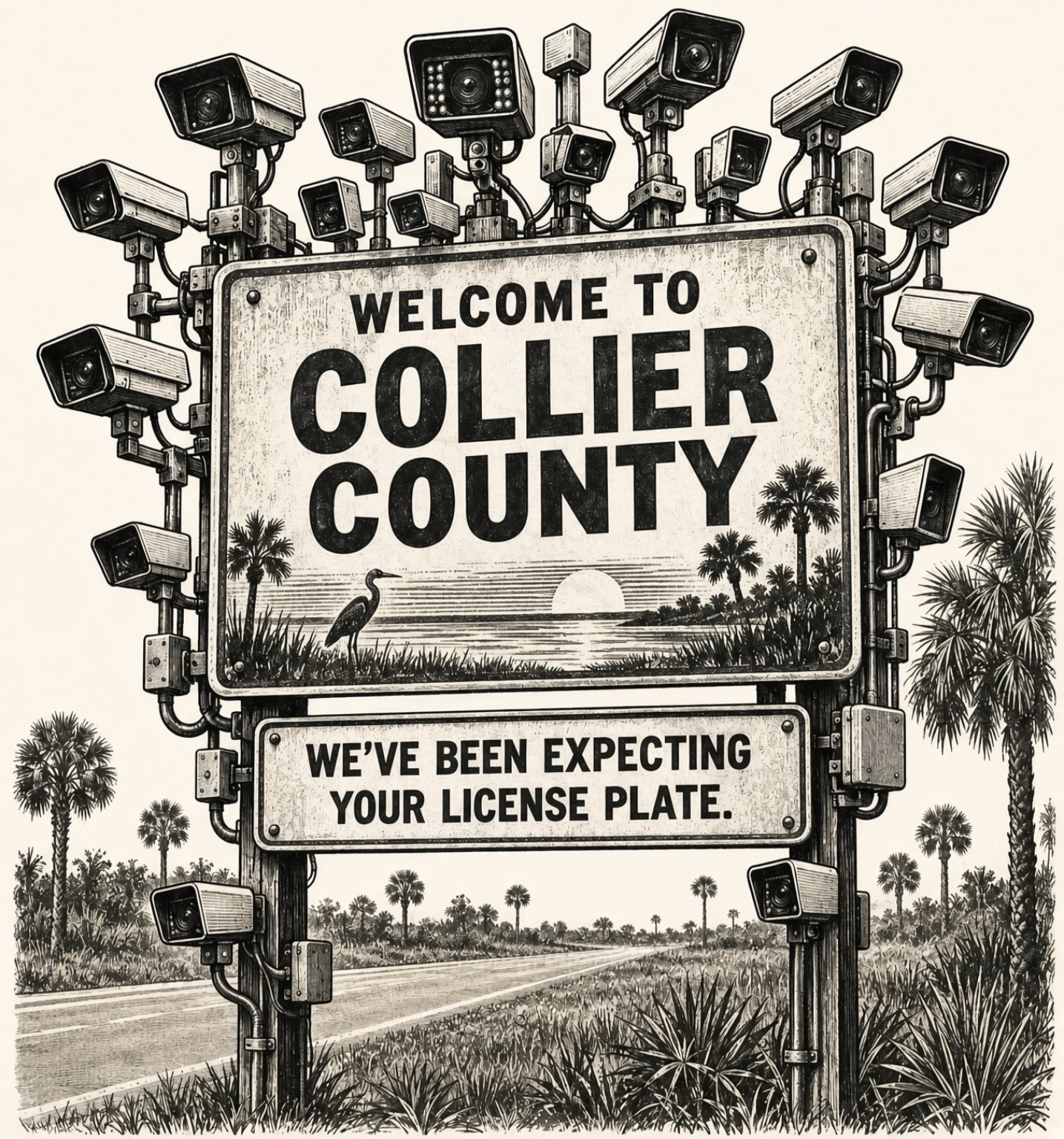
Vintage newspaper-style illustration of a Welcome to Collier County sign surrounded by surveillance cameras, with the message We've been expecting your license plate.

COLLIER’S BLUE-COLLAR ISLAND

Southern Living Declares Marco Island Down-to-Earth; Real Estate Flyers Already Updated

The scrappy island community continues making ends meet with award-winning restaurants, exclusive golf courses and an adults-only rooftop pool.

MARCO ISLAND — Southern Living has officially declared Marco Island “decidedly more down-to-earth” than Naples, confirming what generations of local working families have long suspected: Marco Island is basically the Estates with valet parking.

The national magazine praised the island’s laid-back atmosphere, beautiful beaches, fresh seafood and comparative shortage of luxury-shopping districts. Unlike its “ritzier northern neighbor,” Naples, Marco apparently offers visitors an authentic glimpse into the simple lives of ordinary Americans who summer somewhere with a furnace and winter somewhere with a dock.

The distinction is important. Naples is where wealthy people go to be seen. Marco Island is where wealthy people hang out when they are tired of driving around Naples to be seen.

Evidence of Marco’s down-to-earth character can be found at the JW Marriott, where struggling vacationers must somehow endure 12 restaurants, two golf courses, a bowling alley, a world-class spa and an adults-only rooftop pool. Certain guests also receive access to a private beach and complimentary continental breakfast, just like Steinbeck wrote about.

Marco residents welcomed the recognition, although several reportedly became concerned when they heard the word “earth” and it reminded the city that exposed soil is prohibited by their landscaping guidelines.

Life on the island has never been glamorous. Residents must routinely overcome enormous hardships, including bridge traffic, inconvenient pickleball reservations and the possibility that a restaurant hostess will say “about 45 minutes” without displaying sufficient remorse.

The island’s shops offer resort wear, jewelry, home fragrances and carefully curated souvenirs, allowing ordinary families to purchase the basic necessities of life provided those necessities coordinate with coral.

Even the local restaurant scene reflects Marco’s blue-collar character. At The Oyster Society, diners can enjoy an Oceanic Platter featuring oysters, clams, half a lobster, jumbo shrimp, blue crab salad, scallop ceviche and a pound of crab—an economical survival ration traditionally shared by generations of island fishermen.

Visitors seeking something even more rustic can travel to Goodland, the tiny fishing village located just beyond Marco’s psychological border. There, actual working boats, commercial fishermen and buildings without mandatory earth tones provide an immersive historical demonstration of what “down-to-earth” meant before it became a resort marketing category.

The magazine’s assessment also resolves Marco Island’s place within Collier County’s delicate economic hierarchy.

Naples is rich.

Marco Island is down-to-earth.

Port Royal is a sovereign wealth fund with landscaping.

Golden Gate Estates is where Naples stores everything prohibited by its HOAs.

Marco’s new status may take some adjustment. The island has spent decades cultivating a fiercely independent identity built around beaches, boating and the belief that crossing the Jolley Bridge should require a passport. Now residents must accept their new role as the humble, approachable people of Collier County.

Fortunately, the transition should be painless. Marco has always possessed the essential qualities of a close-knit working-class community: everybody knows everybody, nobody trusts the mainland and while the island may lack Naples’ Fifth Avenue, its residents remain proud of what they do have: six miles of beaches, waterfront dining, luxury resorts and the quiet comfort that comes from knowing someone on your street owns a yacht capable of evacuating directly to the Bahamas.

Source: Southern Living.

NAPLES’ FORMERLY HIDDEN GEM

National Magazine Reveals Naples’ Hidden Beach to Entire Country

Southern Living protects beloved local secret by publishing its name, location, parking instructions, nearby restaurant and recommended hotels.

NAPLES — A small Naples beach known only to locals, nearby residents, Collier County tourism officials, Google Maps and anyone who has ever reached the end of Seagate Drive has now been exposed by a national lifestyle magazine.

Southern Living introduced Seagate Beach to readers Sunday as a hidden Florida destination “that only locals know about,” preserving its obscurity through the traditional method of publishing detailed directions on the internet.

The article identifies the beach, explains where to park, describes the pedestrian entrance, distinguishes it from neighboring Clam Pass and tells visitors where to find food once they arrive.

Authorities have not identified a motive.

The beach access itself, officially known as North Gulf Shore Beach Access, is tucked between waterfront communities near the end of Seagate Drive. Its narrow walkway, lack of amenities and very small parking lot have historically protected it from large crowds through a sophisticated access-control system known as “there’s nowhere to put your car.”

That system may now face its most serious challenge yet.

The magazine specifically notes that limited parking helps keep crowds away, a theory expected to be tested once several million readers enter “Seagate Beach” into their phones and begin circling the same 38 spaces.

Visitors unable to find a space will be invited to participate in an authentic Naples tradition: driving slowly through an affluent neighborhood while pretending to be “just looking for the beach” and not considering a permanent move.

There are no restrooms or concessions at the beach itself. Until now, these conditions were generally considered drawbacks. The national travel industry has reclassified them as “unspoiled.”

Hungry beachgoers can walk approximately a quarter-mile to the café at Clam Pass, assuming they possess the stamina, adequate hydration and necessary wilderness training to reach the beachfront restaurant operated by the Naples Grande.

The article also recommends nearby family attractions, restaurants and luxury accommodations, ensuring that anyone unfamiliar with this closely guarded local secret now has a complete operational plan.

Naples has always maintained a complicated relationship with publicity. The community spends millions encouraging people to visit, then reacts with genuine surprise when they do. The ideal Naples attraction is nationally famous, internationally admired and completely empty when a resident wants to use it.

The magazine recommends visiting during the quieter summer months, when dolphins and manatees are more active, crowds are smaller and the heat gently discourages anyone whose family has not spent three generations adapting to air that can be worn.

Local officials have not announced any formal response to the disclosure. Possible emergency measures include removing Seagate Drive from Google Maps, renaming the beach “Stormwater Outfall No. 6” and telling prospective visitors that it is technically in Fort Myers.

None is expected to work.

The secret is out. The directions are online. The parking lot remains limited.

By next season, Seagate Beach should achieve Naples’ highest form of popularity: locals telling everyone it used to be better.

Sources: Southern Living and Naples, Marco Island & the Everglades Convention and Visitors Bureau.

THE GREAT MIGRATION GETS A NONSTOP

RSW Adds Direct Flight to Michigan, Streamlines Delivery of Future Residents

FORT MYERS — Allegiant will begin year-round nonstop service between Flint, Michigan, and Southwest Florida International Airport on February 11, eliminating the last major logistical obstacle between Mid-Michigan and Naples condo ownership.

The route will allow passengers to travel directly from Flint to Fort Myers without connecting, changing planes or spending several transitional years in Ohio.

Southwest Florida officials expect the flight to carry vacationers, seasonal residents and people who insist they are “only visiting” while browsing Zillow from the airport.

Return flights will also be available for the occasional passenger who remembers they still own a house in Michigan.

Source: Allegiant.

GEOGRAPHY REMAINS OPTIONAL

Cars on 5th Moves to Bayshore; Name Staying Downtown

After more than two decades, Naples discovers that Fifth Avenue is less a location than a state of mind.

NAPLES — Cars on 5th will relocate from Fifth Avenue South to Bayshore Drive in 2027 while continuing to operate under the name Cars on 5th.

The move follows months of discussion with the City of Naples about traffic, safety and the logistical challenges of placing more than 750 vehicles and thousands of spectators on a downtown street already occupied by vehicles and thousands of spectators.

The main concours is scheduled for February 6 along Bayshore Drive, where rare, exotic and classic cars will be displayed several miles from the avenue specifically identified in the event’s name.

Organizers now promote it as “Cars on 5th: Naples Bayshore,” confirming that Fifth Avenue is no longer a physical location but an upscale automotive concept and 5th Avenue state of mind.

Beginning next year, anyone asking where to find Cars on 5th will receive the most Naples answer possible:

Not on Fifth.

Sources: Naples Automotive Experience and Gulf Coast News.

EDITOR’S NOTE: PLEASE STOP JINXING US

Local meteorologists are respectfully reminded that repeatedly celebrating our hurricane-free season while the Atlantic is still warm constitutes reckless ocean taunting.

Please stop calling it a “quiet year,” pointing confidently at the empty tropics or saying “so far” on television.

We have been through enough.

End of the second edition.Keep a copy · Download the PDF ↓